
Geochelone elegans (Sri Lankan Star Tortoise)
The Sri Lankan Star Tortoise: Walking Works of Art (Geochelone elegans)
The Star Tortoise is one of the most visually striking reptiles on Earth, a terrestrial tortoise whose elaborately patterned shell has made it both an ecological icon and a prime target for the illegal wildlife trade. The Sri Lankan population is often treated as a distinct subspecies due to its larger body size compared to Indian populations. Found primarily in the island's dry and semi-arid zones — particularly the Northern and Eastern provinces and the dry lowlands of the North Central Province — this tortoise is listed as Vulnerable by the IUCN, with populations under severe pressure from collection for the international pet trade and habitat degradation.
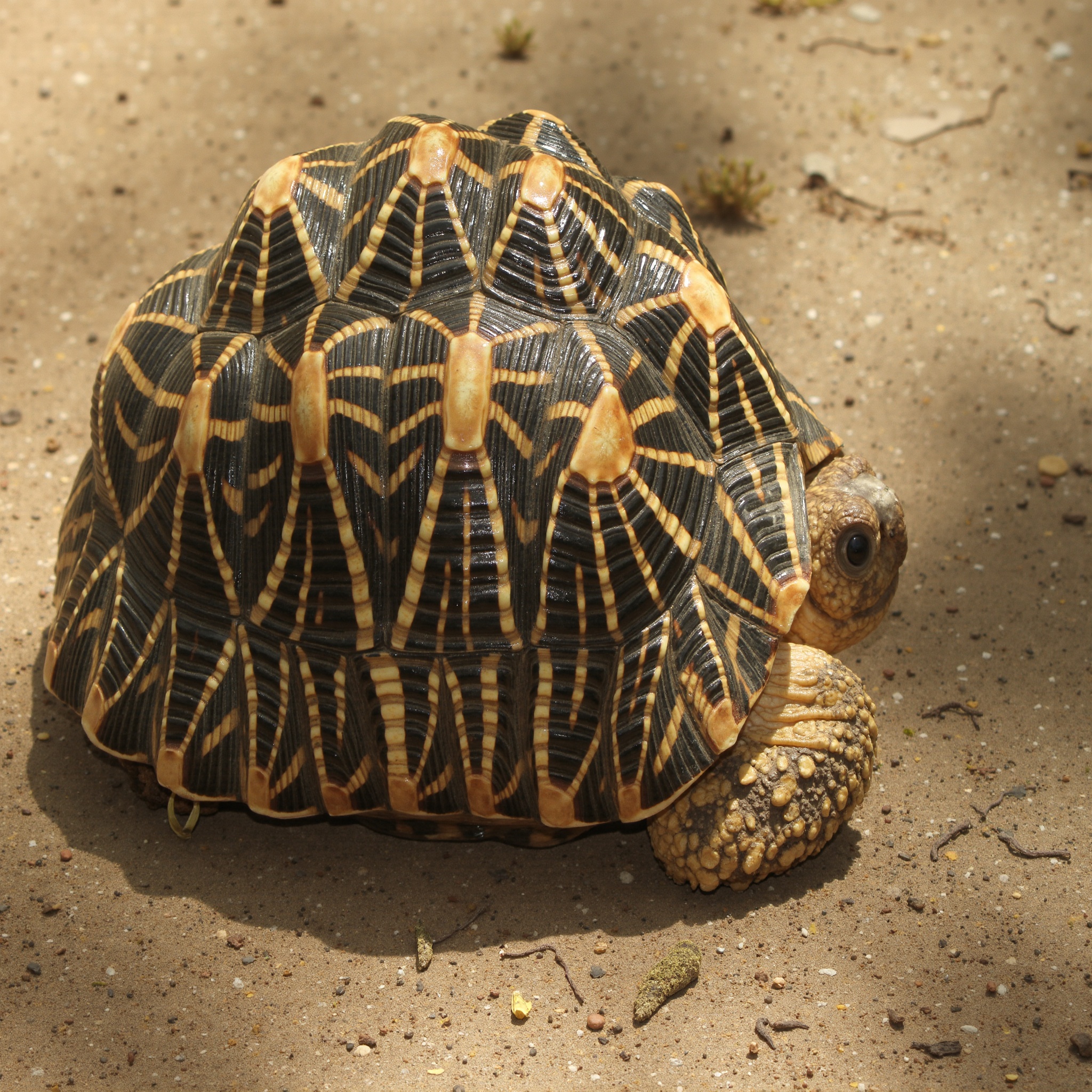
The Star Tortoise derives its common name from the extraordinary geometric pattern on its highly domed carapace: each of the scutes is raised into a pyramid and marked with yellow lines radiating outward from the centre against a black background, creating a stunning star-like motif. Sri Lankan individuals tend to be larger than their Indian counterparts, with females reaching up to 30 cm in carapace length and weighing up to 6–7 kg — males are considerably smaller. The yellow and orange pigmentation intensifies with age. The skin of the head and limbs is yellow-orange with darker scales, and the limbs are elephantine and robust, well-suited for moving across rocky, sun-baked terrain.
Star Tortoises are herbivores, grazing on grasses, succulents, fallen fruits, flowers, and the leaves of low shrubs. They are most active during the cooler hours of early morning and late afternoon, retreating to shade during the peak heat of the tropical day. The species is sexually dimorphic — females are substantially larger than males. Mating behaviour involves males butting their shells against females, and clutches of 2–10 eggs are laid in shallow nests dug in sandy soil. Hatchlings are more vividly patterned than adults and are extraordinarily vulnerable to predation in their first years of life.
The illegal wildlife trade represents the most acute threat to Sri Lankan Star Tortoises. The species is listed on CITES Appendix II, restricting commercial trade, and on Appendix I in some management frameworks. Despite this, thousands of individuals are smuggled annually from Sri Lanka — primarily through the Colombo airport — destined for pet markets in East Asia and Europe. Habitat loss from agricultural encroachment into dry-zone forests also reduces population viability. Sri Lanka's Department of Wildlife Conservation, in collaboration with international partners, has established rescue and rehabilitation centres and conducts education campaigns to reduce local collection, but enforcement of trade restrictions remains inconsistent.