
Melursus ursinus inornatus (Sri Lankan Sloth Bear)
The Sri Lankan Sloth Bear: A Gentle Giant (Melursus ursinus inornatus)
The Sri Lankan Sloth Bear is a fascinating and often misunderstood inhabitant of the island's dry-zone forests. As the only bear species found in Sri Lanka, it holds a unique ecological niche as both insectivore and frugivore, playing a vital role in controlling termite populations and dispersing seeds across the forest. Classified as Vulnerable by the IUCN, the Sri Lankan subspecies (M. u. inornatus) is geographically isolated from the Indian mainland population and is considered genetically distinct, with a coat suited to the island's warmer tropical climate.
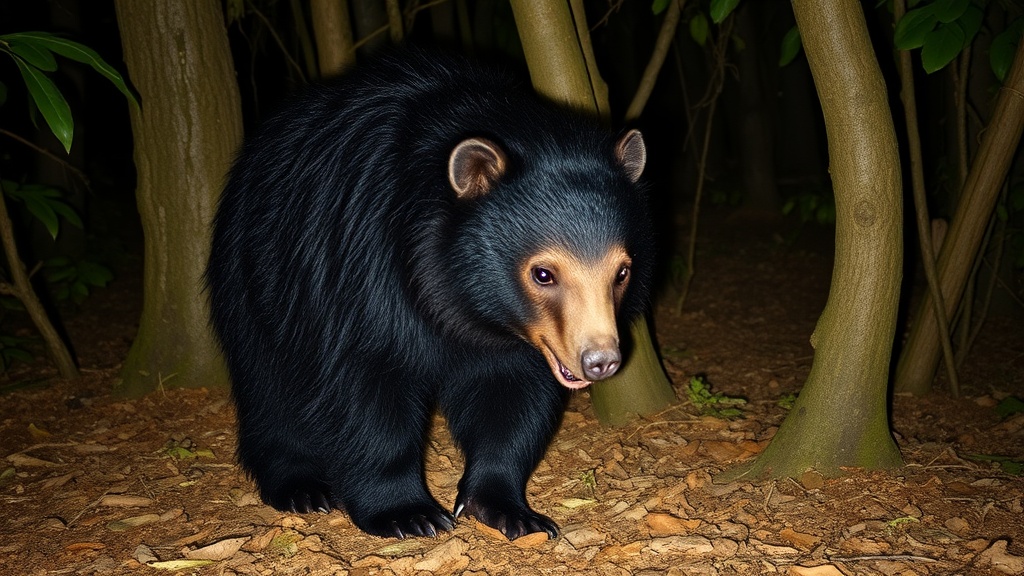
Physically, the Sri Lankan Sloth Bear is a medium-sized bear with a distinctive appearance that sets it apart from other carnivores on the island. Adults typically weigh between 55 and 145 kg and stand about 70 cm at the shoulder. Their most recognisable features include long, shaggy black fur, a mobile and elongated snout, large curved ivory-coloured claws perfectly adapted for ripping open rock-hard termite mounds, and a striking pale V-shaped marking on the chest. Unlike bears from colder climates, the Sri Lankan subspecies often has a shorter coat adapted to the heat.
Sloth Bears are primarily nocturnal and insectivorous, with termites and ants forming the bulk of their diet. They are equipped with a remarkable feeding adaptation: they close their nostrils voluntarily, use their long lips to form a tight tube, and create a powerful suction to vacuum insects directly from nest galleries — a strategy so effective and audible it can be heard over 100 metres away. In addition to insects, they also consume honey, wild fruits, tubers, and the flowers of Madhuca trees. In Sri Lanka, they are concentrated in the protected dry-zone forests of Yala, Wilpattu, and Wasgomuwa National Parks, where suitable termite-mound habitat is plentiful.
Conservation of the Sri Lankan Sloth Bear faces significant challenges. Human–bear conflict is the primary threat: as agricultural land encroaches on forest margins, bears increasingly raid crops and beehives, leading to retaliatory killings. Habitat fragmentation between protected areas reduces genetic diversity and limits dispersal corridors. Conservation organisations are working with local communities on conflict mitigation strategies including electric fencing around apiaries, community education programmes, and rapid-response teams to reduce retaliatory incidents. Protecting the remaining dry-zone forest corridors is essential for the long-term survival of this remarkable and uniquely Sri Lankan bear.