
Semnopithecus vetulus (Purple-faced Langur)
The Purple-faced Langur: Sri Lanka's Canopy Sentinel (Semnopithecus vetulus)
The Purple-faced Langur is one of Sri Lanka's most charismatic endemic primates, a leaf-eating monkey that inhabits a wide range of forest types from the island's wet lowlands to the montane cloud forests of the Central Highlands. Endemic to Sri Lanka, the species is listed as Endangered by the IUCN, with population declines driven by rapid deforestation, urban expansion, and the fragmentation of remaining forest patches. Four subspecies are recognised across the island, each adapted to its particular ecological zone — from the southwestern wet zone forests to the drier northern and eastern regions.
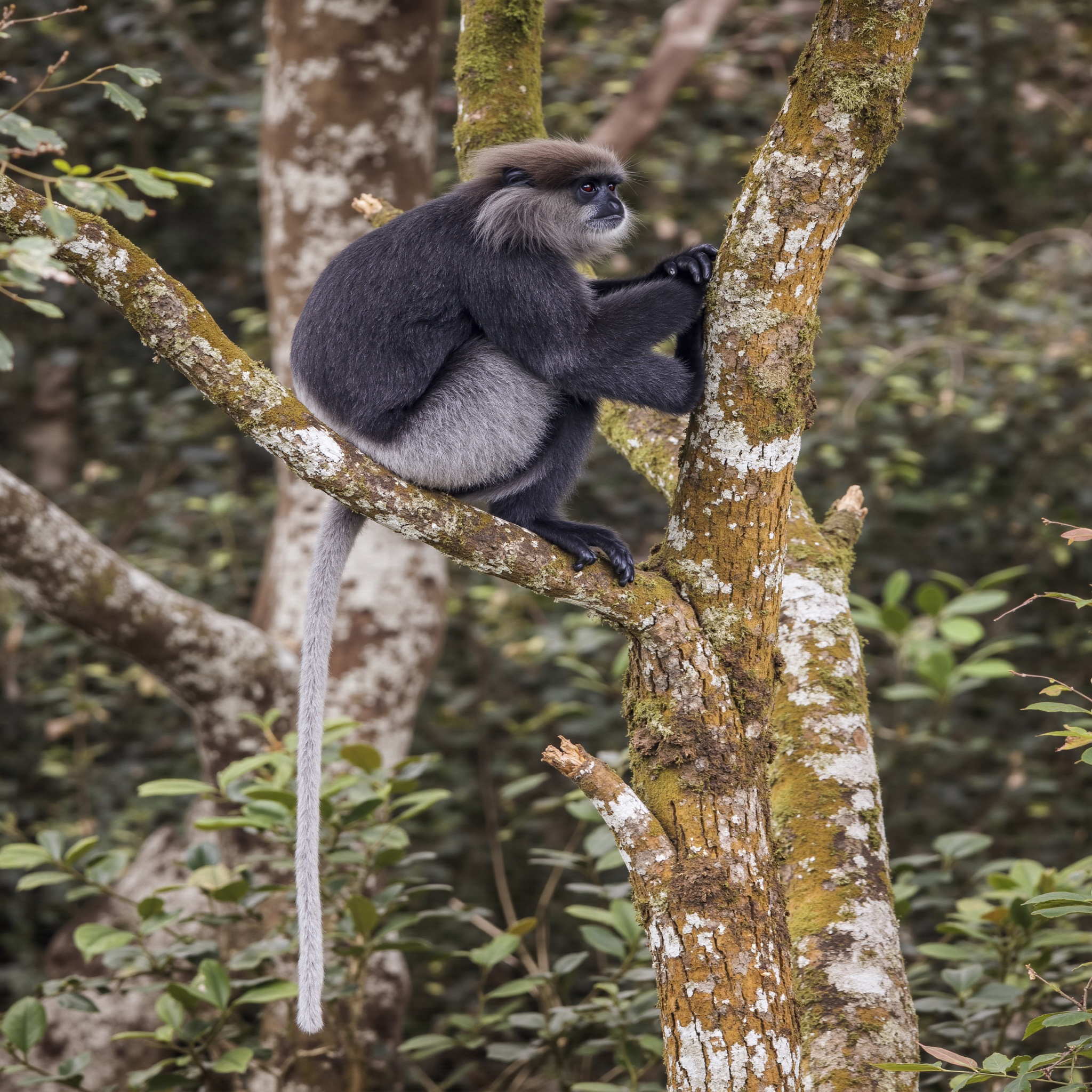
The Purple-faced Langur is immediately recognisable by its striking facial colouration: the bare skin of the face ranges from deep purple to black, framed by a conspicuous ruff of pale whitish-grey whiskers that radiates around the face like a halo. The body is covered in dark grey-brown fur, and the species has an exceptionally long tail — often exceeding the body length — used for balance while leaping between tree canopies. Adults weigh between 5 and 10 kg. Juveniles are born with distinctly paler fur and gradually acquire adult colouration as they mature.
As folivores, Purple-faced Langurs consume predominantly leaves, flowers, unripe fruits, and seeds. Their complex multi-chambered stomachs, much like ruminants, harbour specialised bacteria that break down cellulose and neutralise plant toxins — an adaptation that allows them to subsist on a diet that would be indigestible to most mammals. They live in social groups typically consisting of one dominant male, several females, and their offspring. In suburban Colombo and Kandy, where forests have been largely cleared, adaptable populations now inhabit gardens and urban tree canopies, often coming into conflict with residents.
Protecting the Purple-faced Langur requires urgent action on habitat connectivity. The species cannot survive in small isolated forest fragments and depends on continuous canopy corridors to move between feeding and breeding sites. Urban populations in cities like Colombo and Kottawa are particularly vulnerable to electrocution on power lines, road kills, and dog attacks. Conservation efforts led by the Rainforest Protectors of Sri Lanka and other NGOs focus on creating wildlife-friendly urban green corridors, fitting power lines with insulating sleeves, and working with local communities to foster coexistence with this striking and ecologically important primate.