
Prionailurus viverrinus (Fishing Cat)
The Fishing Cat: Wetland Ambush Predator (Prionailurus viverrinus)
The Fishing Cat is one of Sri Lanka's least-studied and most endangered wild cats, a medium-sized felid supremely adapted to life in and around aquatic habitats. Classified as Vulnerable by the IUCN, this secretive and largely nocturnal predator inhabits mangrove forests, reed beds, freshwater marshes, and the vegetated banks of rivers and streams throughout the island's low country. Sri Lanka represents an important stronghold for the species, which has declined precipitously across much of its Asian range due to wetland destruction and hunting.
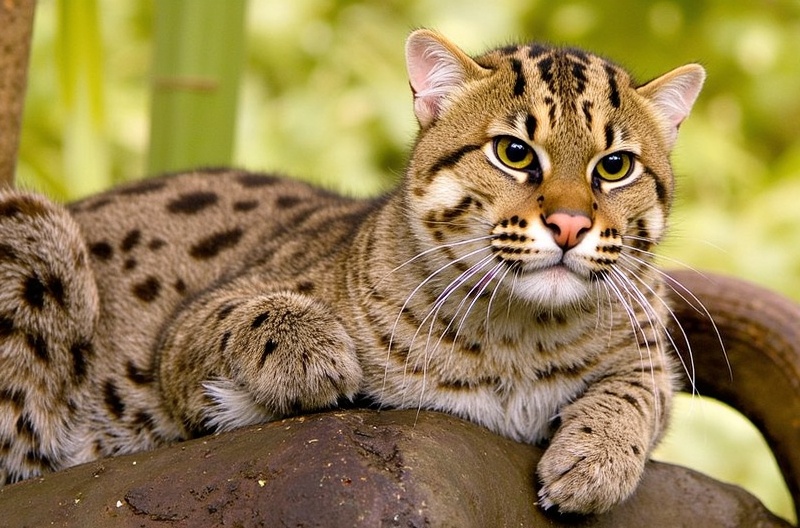
The Fishing Cat is a stocky, powerful cat with a body length of 57–78 cm and a weight of 5–16 kg, making it roughly twice the size of a domestic cat. Its coat is greyish-olive, patterned with elongated dark spots arranged in horizontal rows — a camouflage perfectly suited to the dappled light of wetland margins. One of the most fascinating anatomical features is the partially webbed forepaws, which provide traction and sensitivity when scooping fish from the water. Two layers of fur — a short dense waterproof undercoat and longer outer guard hairs — help insulate the animal during aquatic forays. The tail is shorter relative to body length than in most cats, an adaptation for dense wetland vegetation.
True to its name, the Fishing Cat preys heavily on fish, frogs, crustaceans, snakes, and water birds, ambushing prey from the water's edge or wading into shallow water with remarkable stealth. It is one of the few wild felids observed to swim competently and even dive to pursue fish. Territorial and solitary outside of mating season, individuals maintain large home ranges encompassing multiple wetland habitats. Camera trap studies in Sri Lanka have recorded Fishing Cats at sites ranging from Colombo's urban wetlands and the Muthurajawela marshes to the mangroves of the Northern Province.
The destruction and degradation of wetland habitats is the Fishing Cat's single greatest threat. In Sri Lanka, mangroves have been cleared for aquaculture, rice paddy conversion, and coastal development at an alarming rate. Freshwater marshes are drained for agriculture and housing. Additionally, Fishing Cats are frequently caught in wire snares set for other animals, and are sometimes killed by fishing communities who regard them as competitors. Conservation programmes are working to document the species' distribution across Sri Lanka using camera traps, raise awareness among fishing communities, and advocate for stronger legal protection of remaining wetland ecosystems.