
Balaenoptera musculus (Blue Whale)
Blue Whale off Mirissa: The Ocean's Greatest Creature (Balaenoptera musculus)
The waters off the southern coast of Sri Lanka, particularly around the coastal town of Mirissa and the deeper channels approaching Dondra Head, offer one of the most reliable and accessible opportunities anywhere in the world to encounter the Blue Whale — the largest animal ever known to have lived on Earth. Sri Lanka's position at the confluence of rich upwelling currents in the northern Indian Ocean creates ideal conditions for aggregations of krill and small fish, the primary prey of this oceanic giant. Blue Whales are classified as Endangered by the IUCN, with global populations still far below pre-whaling levels despite decades of international protection.
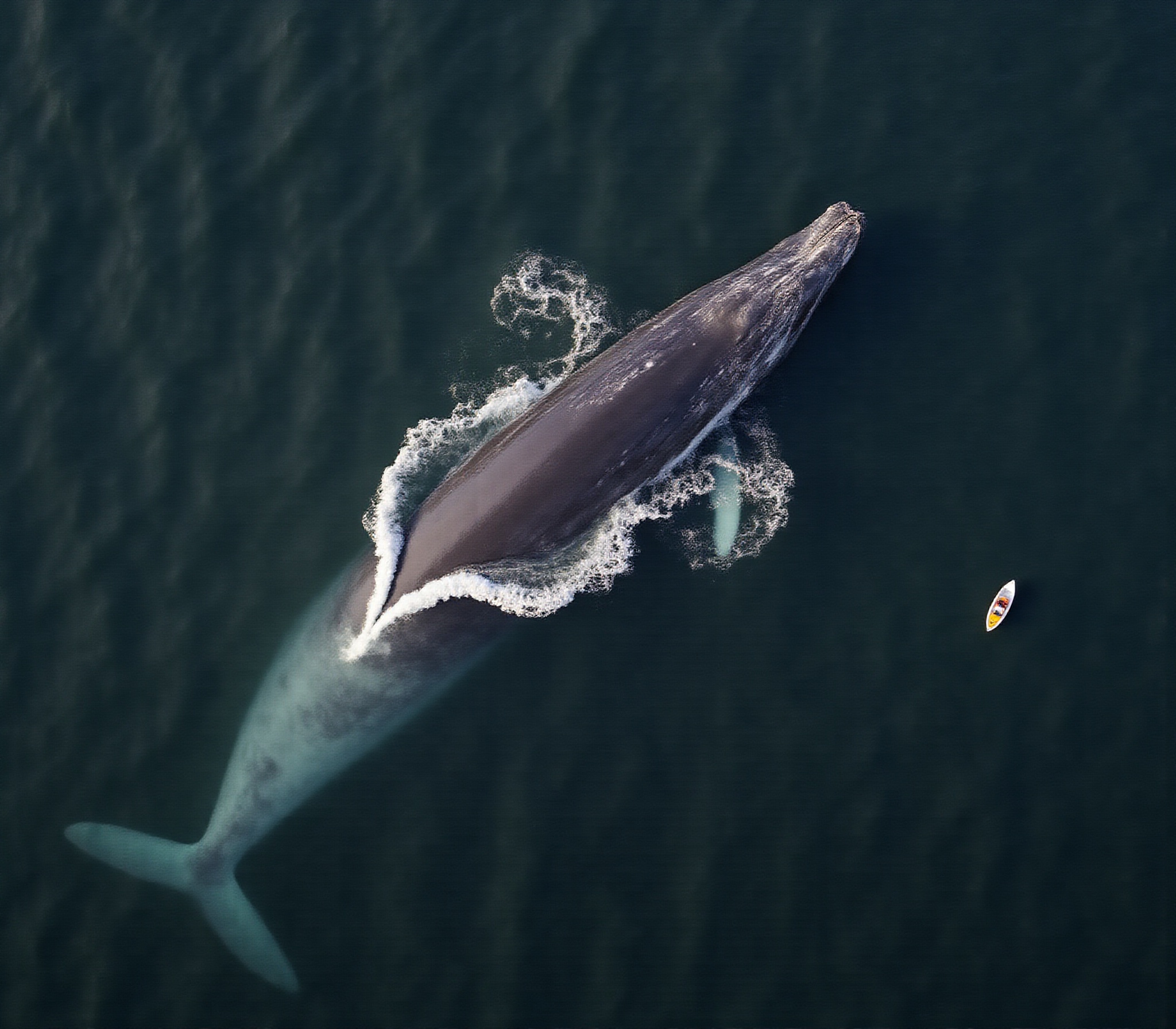
The Blue Whale is an animal of superlatives. Adults can reach 24–30 metres in length and weigh up to 180 metric tonnes — heavier than any dinosaur for which we have good fossil evidence. The body is a mottled blue-grey, appearing a striking iridescent blue when seen through the water. The flippers are long and pointed, and the tiny dorsal fin is set far back on the body. The species belongs to the baleen whale family; instead of teeth, it has rows of black baleen plates that filter enormous quantities of krill from the water. A single adult blue whale can consume up to 4 tonnes of krill per day during peak feeding. The blow — the column of water vapour and mucus exhaled from twin blowholes — can rise up to 12 metres and is visible from kilometres away.
Off Mirissa, Blue Whales are typically encountered from November through April, when the seas are calmer and cetacean activity peaks in the Indian Ocean feeding grounds. The channel between Sri Lanka and the Maldives forms part of a major Blue Whale migration route, and the species is remarkably predictable in its appearance here compared to most global locations. Sperm Whales, Spinner Dolphins, Bryde's Whales, and occasionally Fin Whales and Killer Whales are also observed in the same waters, making Mirissa one of the premier cetacean watching destinations in South Asia.
The conservation of Blue Whales off Sri Lanka faces several significant challenges. Ship strikes are a major cause of mortality: the busy international shipping lanes that traverse Sri Lanka's southern waters pass directly through prime Blue Whale habitat, and the Sri Lanka Navy has worked with the International Whaling Commission to trial voluntary speed restrictions and lane adjustments near Dondra Head. Noise pollution from shipping traffic disrupts whale communication, which occurs over extraordinary distances at low frequencies. Unregulated whale-watching boats can also cause stress and disrupt feeding and resting behaviour. Responsible cetacean tourism — maintaining minimum approach distances and engine-off drift protocols — is advocated by conservation operators to ensure that whale watching in Mirissa remains both sustainable and scientifically valuable.